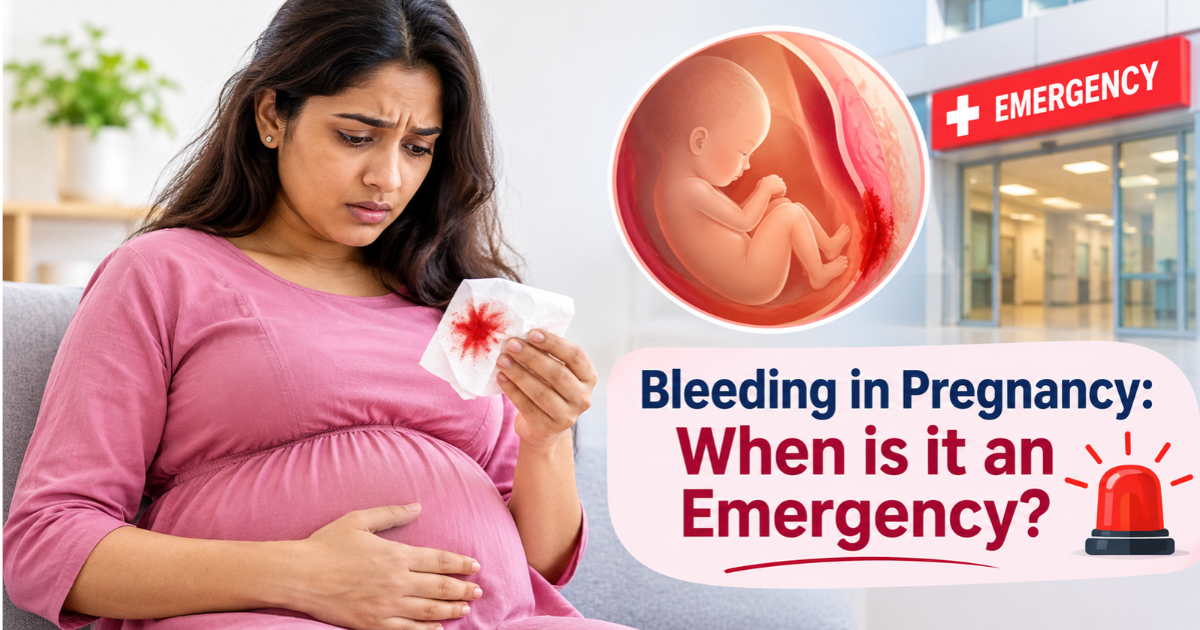
Seeing blood when you're pregnant is frightening. The honest answer is that bleeding is common, especially early on, and many women who bleed go on to have a healthy pregnancy. But some bleeding needs a doctor immediately. This guide helps you tell which is which, so you know whether to go to hospital now, call your doctor today, or mention it at your next visit.
Heavy bleeding, fainting or severe pain? Call 108 or go to the nearest hospital now. Don't wait for this page, an appointment or a callback.
How common is bleeding in pregnancy?
Bleeding in the first trimester (up to 12 weeks) happens in roughly 15–25% of pregnancies, according to the American College of Obstetricians and Gynecologists (ACOG). In a large study of over 5,000 women published in ACOG's journal, about 1 in 4 reported some first-trimester bleeding, and bleeding on its own did not raise the risk of pregnancy loss when the scan matched the expected dates. That's reassuring. It doesn't mean you should ignore it. Bleeding is a symptom, not a diagnosis, and only an examination and a scan can tell you the cause.
Early pregnancy (up to 12 weeks): common causes
- Implantation bleeding: light spotting around the time your period would have been due.
- Cervical changes: the cervix has more blood supply in pregnancy and can bleed lightly after intercourse or an internal examination.
- Subchorionic haematoma: a small collection of blood near the pregnancy sac, often seen on scan, and often settles.
- Threatened miscarriage or miscarriage: bleeding with cramps can be a sign. Not every bleed means this.
- Ectopic pregnancy: a pregnancy growing outside the womb, usually in a tube. This is the one we never want to miss.
Later pregnancy (after 20 weeks): why it's treated differently
Bleeding in the second half of pregnancy should always be checked the same day. Causes include a low-lying placenta (placenta praevia), the placenta starting to separate (abruption), cervical causes, or the start of labour. A "show", a little pink or brown mucus near your due date, can be normal, but fresh red bleeding is not something to wait on.
Brown, pink or red: does the colour matter?
Colour gives a clue, not an answer. Brown usually means older blood leaving slowly; pink or red means fresher bleeding. Amount, pain and how far along you are matter more than colour alone. Use the triage below.
Is this an emergency? Your triage guide
Go to the nearest hospital now (or call 108) if:
- bleeding is heavy (soaking a pad in an hour or less), or you pass clots;
- you feel faint, dizzy or your heart is racing;
- you have one-sided tummy pain, or shoulder-tip pain, in early pregnancy (possible ectopic);
- bleeding comes with strong pain or a hard, tender tummy;
- you're past 20 weeks and have any fresh red bleeding;
- your baby is moving less than usual along with bleeding.
Call your doctor today if:
- you have light spotting or brown discharge in early pregnancy with no pain;
- you had light bleeding after intercourse or an internal check;
- you're Rh-negative and have any bleeding (you may need an injection to protect future pregnancies; your doctor will decide).
Mention at your next visit if:
- you had a single episode of very light spotting that stopped, weeks ago, and your doctor already knows and has scanned you.
What will the doctor do?
Expect questions (how much, what colour, any pain, last scan), a gentle examination and usually an ultrasound. Blood tests may be done to check your blood group and haemoglobin. The aim is to find the cause and check the pregnancy, not to alarm you.
While you wait to be seen
- Wear a pad, not a tampon, so the amount can be judged.
- Avoid intercourse until you've been checked.
- Don't take any medicine for the bleeding on your own or on advice from a relative or the internet.
- Bring your antenatal file and scan reports.
In Hyderabad: what to do right now
If you have any of the "go now" signs above, call 108 or have someone take you to the nearest hospital with a 24-hour labour room. Please don't drive yourself. If you live or work around Financial District, Nanakramguda, Narsingi, Kokapet, Puppalaguda, Manikonda or Khajaguda, save two numbers in your phone today: 108, and the labour-room number of the hospital where you plan to deliver. Keep your antenatal file and latest scan reports in your bag from 28 weeks onward, so whoever sees you can read your history quickly.
Frequently Asked Questions
Is light bleeding normal in early pregnancy?
Light spotting is common in early pregnancy and is often harmless, but it should still be reported to your doctor the same day, so they can decide whether you need a scan.
Does bleeding mean I'm having a miscarriage?
Not necessarily. Many women who bleed in early pregnancy continue to a healthy pregnancy. A scan and examination are needed to know the cause.
Is brown discharge in pregnancy dangerous?
Brown discharge is usually older blood and is often less worrying than fresh red bleeding, but call your doctor if it's new, ongoing, or comes with pain.
Is bleeding in the third trimester an emergency?
Fresh red bleeding after 20 weeks should be checked the same day, and immediately if it's heavy, painful, or your baby is moving less.
What should I do if I bleed at night?
If any "go now" sign is present, call 108 or go to the nearest hospital with a 24-hour labour room. Don't wait until morning.
This article is general information and not a substitute for medical advice. If you are bleeding and unsure, get examined.